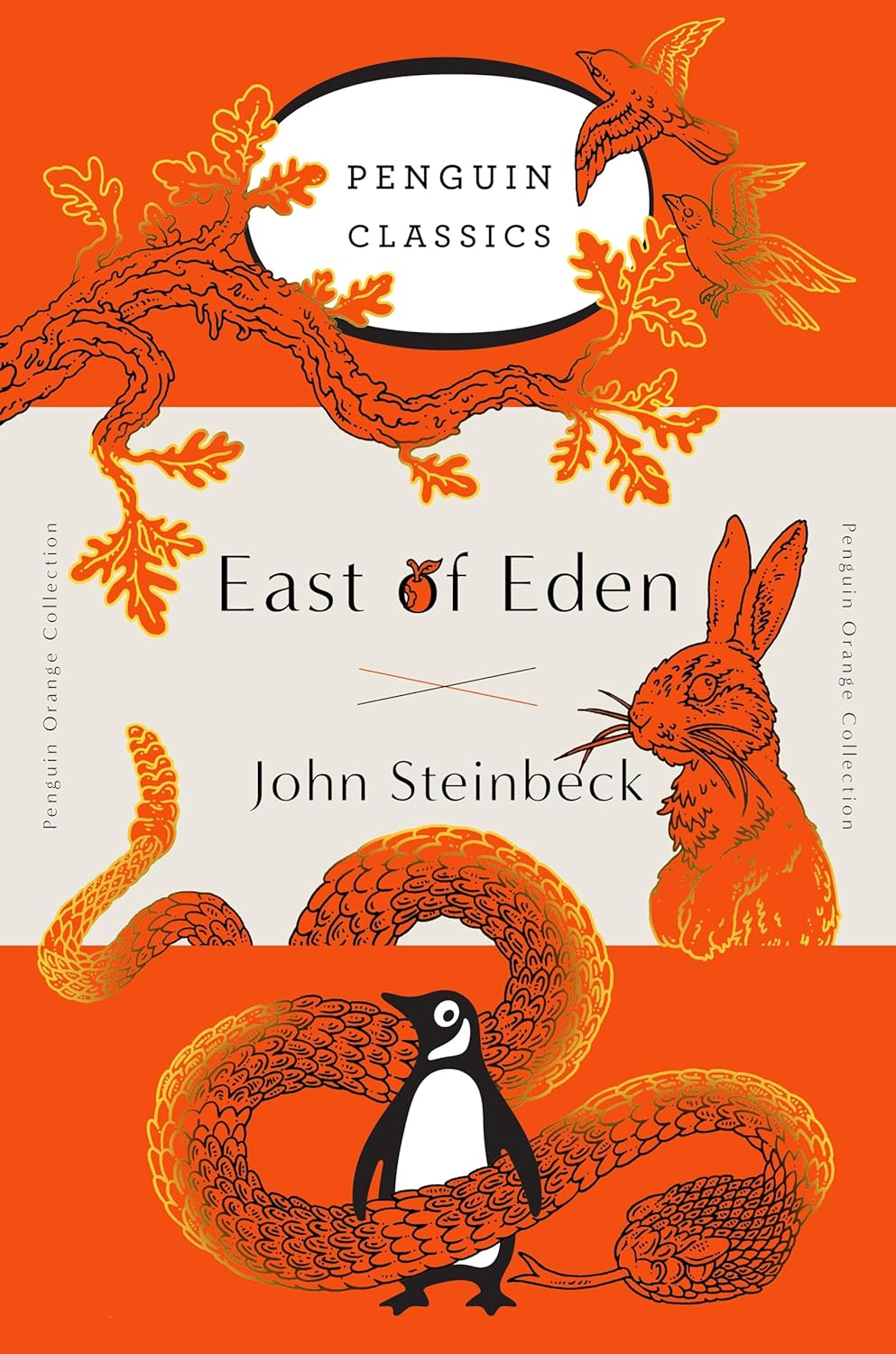
by John Steinbeck
About two years ago my best friend and I were talking about books, as we often are, and about how we found ourselves struggling to read our aspirational list of “classics” since finishing college. So we decided to form a mini book club of two so that we could read together and focus on whittling down our Classics TBRs. Our latest read: East of Eden.
East of Eden is a masterwork by John Steinbeck, a retelling of the Biblical Book of Genesis melded together with the myth of the American Dream. The Nobel Prize winner’s epic spans decades, focusing primarily on Adam Trask and his family from his youth spent in the Spanish-American war, through turn of the century and into the spring of 1918.
Adam begins his life with his abusive father and brother in New England, serves in the military, and eventually moves to Salinas, California with his sociopathic new bride Cathy. The rest of the book unfolds in the scenic Salinas Valley, Steinbeck’s home, with the Trasks and the Hamilton clan, led by their patriarch, Samuel.
We watch Adam’s life leave him after birthing their twin sons, we see the impact Samuel, and his wife Lisa, have on everyone around them, Adam included, we watch those twins grow up under the care of a Chinese man called Lee, who enters the Trask house as a servant and grows to be a partner and parent. We see people fall in and out of love, we see children lose their parents and parents lose their children, we see two boys developing a conscience, we see the age old battle of humanity, good versus evil.
Steinbeck was truly an incredible author, his prose in consistently clear and plainspoken while being deeply profound. He weaves themes of brotherhood, jealousy, and blessings, the themes of the biblical Adam and his sons, through the lives of multiple characters. He chooses the name of each character with care and intention.
I remember thoroughly enjoying Grapes of Wrath when I read it in high school, so I had high hopes coming into Eden, and my expectations were completely blown out of the water.
Because I read this for a “book club” I thought I’d approach this review, and potentially future Classics Club reviews, like a book club discussion and ask some of the questions my best friend and I focused on as we contemplated this novel. (Spoilers ahead, proceed with caution.)
- Early reviews strongly disliked Cathy/Kate. Why is her character important to the overall themes of the novel?
- How does inheritance – financial and moral – feature in the novel?
- Samuel Hamilton is invoked in memory as much as in life, does he represent more in death?
- Discuss some of the biblical parallels, particularly in the names of the characters.
- Is there a Moses character to complement the twins’ Caleb and Aron? If so, who?
I absolutely loved this book. Every second of it was brilliant and tender, devastating and wise. I left it with some incredible quotes that I’ll be mulling for a long time and having found one of my new favorite literary characters in Lee (with honorable mention to my beloved Samuel Hamilton). It’s one of those books that you finish and want to immediately read again. If you haven’t read it yet, you absolutely need to. I’ll definitely be coming back to Salinas, and if you’ve read it before, I hope you’ll consider returning to it, too.
 Dear Reader Reviews
Leave a comment