
by T.J. Klune
Wallace Price is a middle aged, high-powered lawyer living in a penthouse apartment in the city. He’s known as a bit of a hard-ass at the office, is somewhat recently divorced from his college sweetheart but he’s successful in the courtroom which is all he really cares about. At least, that’s all he cared about before he came to sitting in the back pew of his own funeral.
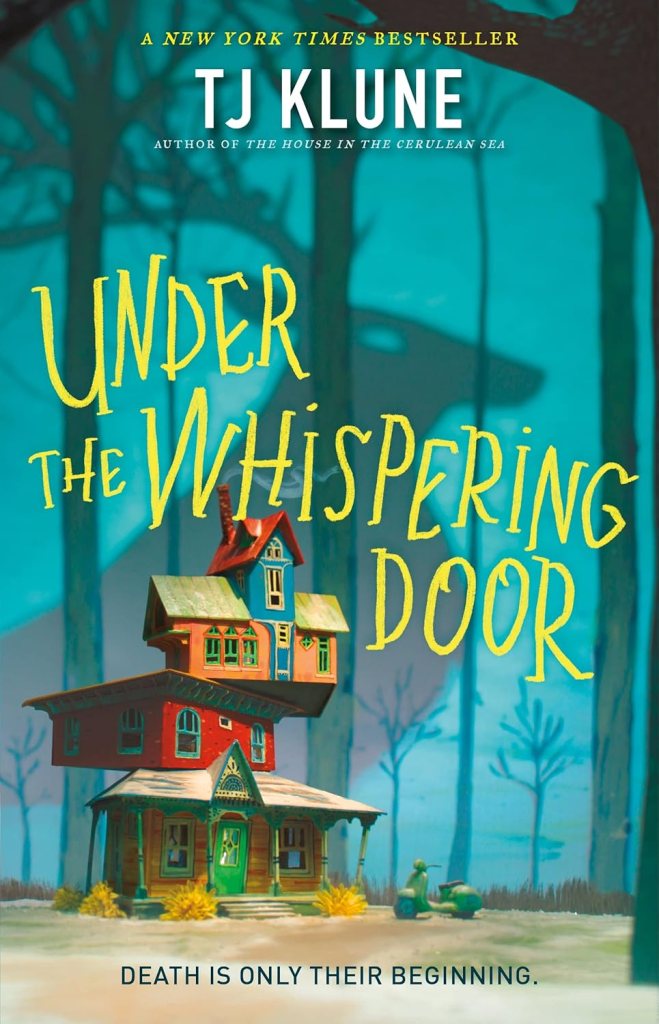
He is whisked away by a young woman claiming to be a Reaper who takes him to a lopsided tea shop in the middle of the woods. At the tea shop he meets Hugo, the ferryman intended to guide him through a mysterious door to whatever comes next. Hugo’s grandfather, Nelson, and therapy dog, Apollo, also live in the tea shop and they, like Wallace are dead.
Weeks pass as Wallace gruffly passes through the stages of grief, the walls, the people and anything else he tries to touch. Nelson, who has been dead far longer than Wallace, teaches him how to manipulate and take advantage of his new ghostly form.
Wallace learns about the afterlife, about ghosts that walk among the living until their ferrymen guide them through their doors, about an all-knowing Manager who intimidates the residents of the tea shop, and how things can go wrong between death and the door. He watches a mother, whose young daughter passed through tea shop after her untimely death due to illness, return to Charon’s Crossing over and over, seeking the girl’s spirit. He encounters the deteriorating, haunted spirit of a young man called Cameron, who fled from the tea shop against Hugo and Mei’ warnings, and exists now in a zombie-like purgatory.
As Wallace develops relationships with each of his new housemates, he begins to grow in ways he never did when he was alive. Each of Klune’s characters are presented with a subtle complexity, even the dog.
TJ Klune is the New York Times bestselling and Lambda Literary Award winning author of In The Lives of Puppets and The House on the Cerulean Sea, among many others. The House was my first introduction to Klune and I absolutely adored it (I am eagerly anticipating the recently released sequel, Somewhere Beyond the Sea to make it into paperback). I plucked Whispering Door off my shelf after finishing East of Eden, in search of something uplifting and warm, and that’s exactly what I found.
Klune is known for his depictions of gay characters and queer relationships in his fantastical fiction. His own queer experiences inform his writing and give his characters a strong sense of authenticity. There is something so natural and warm about the way he writes the emotions and relationships of the queer folks featured in his novels. This novel, as much of Klune’s work, reflects circumstances of his real life. Perhaps writing this story, of death and a sort of resurrection, was a therapuetic experience for its author.
Aside from the inhabitants of the tea shop, I was particularly interested in Klune’s depiction of “The Manager” and his choice to set the story in a tea shop in the first place.
Charon’s Crossing, despite its name and all of its obvious connotations, was a very specific choice for the setting of Wallace’s transformation. I think there were a few reasons Klune chose a tea shop – not a café, not a coffee shop or diner – a tea shop for his story. The simplest reason to me is that a tea shop evokes a sense of coziness and warmth, an old fashioned kind of place that is quieter than a bustling Starbucks and moves at a slower pace than the rest of the world.
Tea also has a rich, deep history in cultures all over the world. Just in the course of the book we see Hugo serve English, Chinese and Mexican teas, among others. Tea is one of the ties that binds us all, and always has, tea has been brewed and drunk for centuries. It’s often a drink that often pulls on not just cultural but familial associations and memories. Wallace drinks peppermint tea and thinks of the candy canes his mother used to make, I drink a black peach tea and think of a date to a very different tea shop with my very different mother when I was a child.
Tea, the people who make it and the places it is served are all rich in cultural and personal histories for many of us.
The first time you share tea with a Balti, you are a stranger. The second time you take tea, you are an honored guest. The third time you share a cup of tea, you become family.
The most significant character outside of the tea shop residents and regulars is a mysterious, all powerful being known as The Manager. Not a god, and certainly not a human, The Manger is an immortal being who, for lack of a better word, manages the dead and the dying.
Most interestingly, Klune chooses to present the Manager in two corporeal forms, a stag and a young boy, both with an imposing presence and flowers blooming in their hair. The stag are recognized as ancient and wise beings in many tales, particularly of Celtic and Native American origin. The stag is associated with spirituality and strength and, most notably, the in between.
I loved his choice to present this powerful, otherworldly being as a child, for a variety of reasons. There is always something disconcerting about children as the face of death, power and wisdom, about watching a child make life and death decisions and speak with the knowledge of the ancient. But Klune was also clever with his little god, the character often behaving in a petulant, childlike manner, both to the betterment and devastation of our protagonists.
I thoroughly enjoyed this quick, uplifting read. While there were elements of heaviness alongside deeply profound moments, this is a book about death and grief after all, it was also a story of love and family and, quite literally, the ties that bind. I rated this 5 stars on Goodreads and I hope you’ll read it and love it as much as I did. I’ll leave you with this particularly exquisite quote:
The sunlight filtered through the trees, melting the thin layer of frost on the ground. He gripped the railing as the light stretched toward him. It touched his hands first. And this his wrists, and arms, and finally his face. It warmed him. It calmed him. He hoped wherever he was going that there’d still be the sun and the moon and the stars. He’d spent a majority of his life with his head turned down. It seemed only fair that eternity would allow him to raise his face toward the sky.
 Dear Reader Reviews
Leave a comment