by Diana Wynne Jones
I recently joined the once monthly Fantasy Book Club at my local book shop (shout out to The Stacks) and the first thing I read was the 80’s British children’s classic Howl’s Moving Castle.
I had, of course, seen Studio Ghibli’s 2004 adaptation of the novel and was curious to learn how faithful Miyazaki was to his source material. I would definitely say the film was more “inspired by” the novel than a straight adaptation, but in a very good way. It remains faithful to the whimsy and coziness of Sophie’s world while softening some of the characters edges.
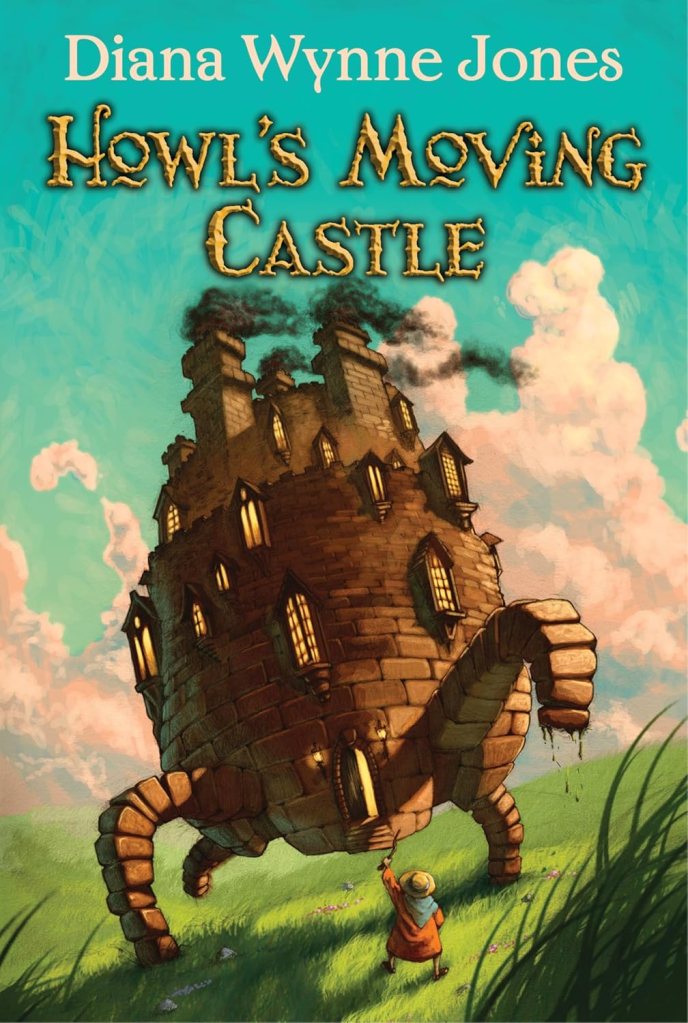
Diana Wynne Jones’s writing was a delight to read, light and fun, with no lack of emotional depth. I always enjoy mixing in the occasional middle grade read, it can be fun to have something young and quick to read. Howl had all the best qualities of good children’s literature, because while it was accessible and fantastical and fun, it was just as moving and poignant as any adult fiction.
In my book club, we talked a lot about the adaptation, of course, but also had a lovely conversation about the novel as it stands by itself. There was a lively discussion about the focus on the rules of fairytales, specifically the destiny of sisters based on birth order.
Sophie spends much of the book convinced that her life must play out in a certain way because she is the eldest daughter. She feels fated to live a quiet life in the family’s hat shop. Her sisters ought to be a lovely lady who marries rich and a witch or some other smart successful woman, but they take pains to change their fortunes. Sophie simply accepts hers.
After Sophia is cursed by the Witch of the Waste so that her physical appearance matches the old soul within, she inserts herself into the household of the wizard Howl, a notorious ladies’ man and stealer of girl’s hearts. She fits herself in among his house, alongside his young assistant Michael and the fire demon Calcifer who resides in the hearth.
Jones subverts many of the rules of folklore while Sophie follows along the hero’s journey. Some tropes stay intact – the meeting of three guides, the dead father and absent stepmother, the wicked witch and animal companions – but many are altered. Sophie pushes back against her blooming magical abilities the whole time, refusing the embrace the role thrust upon her. And Howl is not your typical anti-hero. The vain young wizard is a bit less mysterious in the novel, and I’m pleased to report that his dangly gold earring is a canon detail. His flighty nature and lack of interest in the wars – which are only mentioned in passing and bear little real consequence on the plot and its central characters – is uncharacteristic of a supposed villain.
The rules of magic in this world are funny, too. We learn in the course of the story that Howl is from our world, from Wales to be exact. He loves rugby and has a sister, niece and nephew he visits somewhat regularly. His magic is pulled from the poetry of our world, Donne and Whitman, among others, and he has a traditional education (a PhD!) in the study of magic.
My personal favorite bit of magic in the novel was the falling star. Sophie and Michael, attempted to complete a spell, chase down a falling star.
Sophie tried to say to Michael, Do stop–it’s terrified! But she had not breath left to speak with.
“I only want to catch you,” Michael explained. “I won’t hurt you.”
“No! No!” the star crackled desperately. “That’s wrong! I’m supposed to die!”
“But I could save you if you’d let me catch you,” Michael told it gently.
“No!” cried the star. “I’d rather die!”
Our favorite falling star, the fire demon Calcifer, however, chose not to die. He and Howl struck a deal to keep him alive and to give Howl a sort of freedom. Calcifer staying in the fireplace and used his magic to power the castle’s movement and he held Howl’s heart in his core, a sort of collateral.
We also discussed the rather abrupt ending and the sudden romance between Sophie and Howl. The great climatic battle of the book takes place quite quickly, the novel placing far less emphasis on the war than the film, and before you know it the conflict has concluded. This romantic relationship also seems to bloom from nowhere, which is rather fitting of the genre, but still left us a bit confused. We talked about the few times it may be hinted at earlier in the book. I theorized that perhaps Howl loves Sophie because Calcifer loves Sophie and Calcifer held Howl’s heart.

In all, I really enjoyed the book. The rules of the magic were unique and fun to riddle out. The side by side of this land of roving castles, witches in wastelands, and talking fire demons with a quiet Welsh neighborhood was delightful. The quirks of Sophie and Howl made for a compelling story with a cast of entertaining side kicks. The ending felt a bit rushed, and the romance felt unnecessary, even if it was expected. I’d highly recommend the novel to anyone who is a fan of the movie or a lover of cozy fantasy.
 Dear Reader Reviews
Leave a comment