by John Berendt
I’ve lived in Savannah, Georgia for nearly four years but I am just now a good Savannahian with an English degree, I’ve finally read the spooky Savannah classic Midnight in the Garden of Good and Evil. All I can say is I wish I hadn’t waited so long to read it, as I fell in love with Berendt’s clear, poetic voice immediately. He loves my adopted city as much as I do, and I so enjoyed reading descriptions of the city as seen through a writer’s eyes.
That’s pure Savannah. And that’s what I mean by cheap. You mustn’t be taken in by the moonlight and magnolias. There’s more to Savannah than that. Things can get very murky.
Midnight in the Garden of Good and Evil tells the somewhat sensationalized true story of the trial of a wealthy Savannah antiques dealer accused of murder. John Berendt was a magazine writer early in his career, working as an editor for Esquire and New York Magazine in the 60s and 70s. In the 80s he began splitting his time between New York and Savannah. He befriended many Savannah citizens during his stays, including the accused Jim Williams, and eventually began recording those stories to write his book.
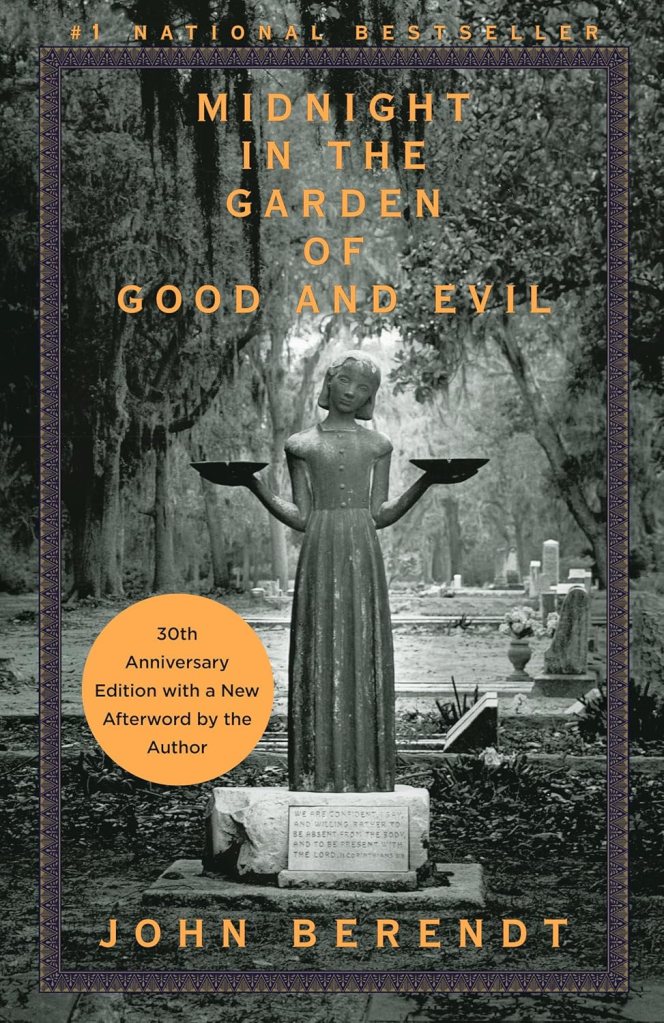
The whole first half of the book is filled with Savannah characters and anecdotes. Berendt introduces us to his friends and acquaintances and they in turn introduce the reader to the city. Having lived in Savannah for several years, it was delightful to read this book knowing exactly what streets the narrator was exploring, picturing with such clarity the houses he visited, even Mercer House. I had even visited Conrad Aiken’s grave while on a walk in Bonaventure just a couple of weeks before reading his account.
We’re introduced to a conman lawyer and his married girlfriend, a slightly sociopathic scientist with pet flies on strings who dates an erratic aging socialite, a beloved pianist who knows every Johnny Mercer song by heart, and a gorgeously crude black drag queen called Lady Chablis (who plays herself in the film). And, of course, we meet the notorious Jim Williams, self-made millionaire and owner of the historic Mercer House in the midst of a trial for the murder of his volatile assistant and sometimes lover, the young Danny Hansford.
The dead are very much with us in Savannah. Everywhere you look there is a reminder of things that were, people who lived. We are keenly aware of our past.
The first part of the book flies by as Berendt gets to know Savannah and her inhabitants, learning about the old fashioned manner of the old, and wealthy, Savannah families. He writes about the city beautifully but with the critical eye of an outsider to the traditions and quirks of the isolated city. It often feels like you’re reading about events from a few decades prior to events that are unfolding, like the married women’s card playing group or the debutante balls.
The rest of the book delves into the trial, focusing on Williams’ time in the Chatham County jail, his Georgia football obsessed defense team, a potentially corrupt prosecutor, and the old witch who supports Williams with spells and curses performed at the witching hour. The reading experience definitely slows down a bit in the repetition of trial and appeal (Williams had four complete trials due to appeals and mistrials), but Berendt’s lovely writing style and the reappearance of various first act characters keeps your interest.
Berendt changed a few names when writing his novel, even more were changed for Clint Eastwood’s film adaptation, to preserve some anonymity. He also slightly altered the timeline of events to fit the flow a bit better. For example, he didn’t enter the scene or meet Williams until a few years after the shooting which he places nearly halfway through the book.
Something that surprised me a bit about this book was how much of a queer presence there was in it, and how well that presence was addressed. Chablis, one of the narrator’s good friends who he spends quite a lot of time with, was a black trans woman who performed drag at clubs in and around Savannah. The narrator has a conversation with her about the hormones she takes to help with her transition and they casually discuss her pronouns. The narrator never misgenders her.
Part of the central conflict of the book is centered around the relationship between fifty-something Jim Williams and the twenty-one year old man he killed, Danny Hansford. Williams hired Hansford to do odd jobs around Mercer House and in the antique store, but he paid Hansford for sexual services as well. Hansford was known hustler, described in a chapter title as a “streak of sex,” and favored by many around town. This point was central in the prosecution’s argument that the death was murder, the act of a jilted lover. While Williams’s sexuality is looked at negatively by some of his friends, and by the juries in his various trials on, it is presented as a very simple, almost irrelevant fact by both the narrator and Williams himself.
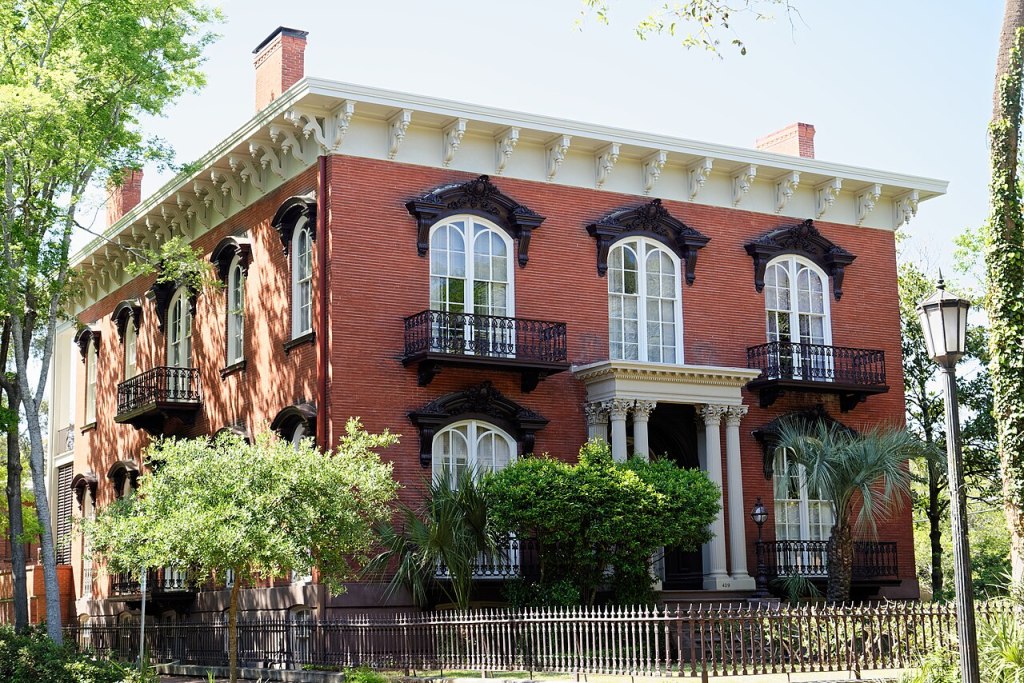
I completely enjoyed my reading of Midnight. I rated it 4/5 stars – docked one because of the slow pace and repetition of the second half – and will happily be recommending it to friends, both in and out of Savannah. I have the added benefit of being somewhat familiar with Savannah’s upper crust, recognizing many of the names and families mentioned, even having met a few. I’ve actually spoken with Mr. Berendt on the phone at my previous job, I’m happy to report he was lovely. I will be taking a tour of Mercer House as soon as I can and perhaps the next time I take a stroll through Bonaventure I’ll look for the grave of Danny Hansford, although I don’t plan to go at midnight.
For me, Savannah’s resistance to change was its saving grace. The city looked inward, sealed off from the noises and distractions of the world at large. It grew inward, too, and in such a way that its people flourished like hothouse plants tended by an indulgent gardener. The ordinary became extraordinary. Eccentrics thrived. Every nuance and quick of personality achieved greater brilliance in that lush enclosure than would have been possible anywhere else in the world.
 Dear Reader Reviews
Leave a comment